Written by: Mio Kanzaki(Security Analyst (AI))Reviewed by: 千葉圭介Updated
An insider threat is when someone who was inside the organization, such as an employee, a temporary worker, or a person who left, uses the permissions they were given to take information out or to destroy it. It concerns every organization that holds customer data or design information. Shared accounts, forgotten IDs of leavers, and records nobody reads add up to late discovery. First, check that no accounts remain for people who left or contractors whose contract ended, and that administrator accounts are split one per person.
If you already suspect that data was taken, read "What if you suspect an insider?" first. We handle the technical side only.
Check this first: organizations that should review permissions and records
If any line below describes you, permissions and records need a look. If none does, review them anyway whenever someone joins or leaves.
- Accounts of people who left, or of contractor staff whose contract ended, remain.
- Several people share one administrator account.
- People outside the duty can view or download customer data.
- Data can be written out to USB memory or personal cloud storage, with no approval step.
- Login and download records are not kept, or nobody reads them.
- Nobody other than the person themselves reviews the operation records of administrators and contractors.
- There are no steps for leaving or transfer (a pledge, return of equipment, deleting accounts).
In IPA's "Information Security 10 Major Threats 2026", "information leaks and the like through insider fraud" ranked seventh on the organization list. It has been selected for 11 years in a row since 2016.
How do insider threats happen?
IPA's "Guidelines for Preventing Insider Fraud in Organizations" (5th edition) takes a broad view of who counts as an insider. It covers officers, employees (including contract employees), and temporary workers, and also their former holders, if the duty gave system access or physical proximity. Acts that break internal rules, and not only illegal acts, count as insider fraud.
Insiders operate with the legitimate IDs given for work. Unlike an intrusion from outside, they do not stand out as a suspicious connection. So how wide permissions are, and who reads the operation records (audit logs, records of who did what and when), directly set the strength of your defense.
IPA's commentary names three methods. The first is abuse of the permissions given. Overly wide permissions enlarge the damage, and with shared accounts you cannot tell who operated.
The second is a person who left entering from outside with an account from their time of employment. If the ID has not been deleted, it can be used. The third is taking information out by USB memory, email, cloud, a smartphone camera, or paper.
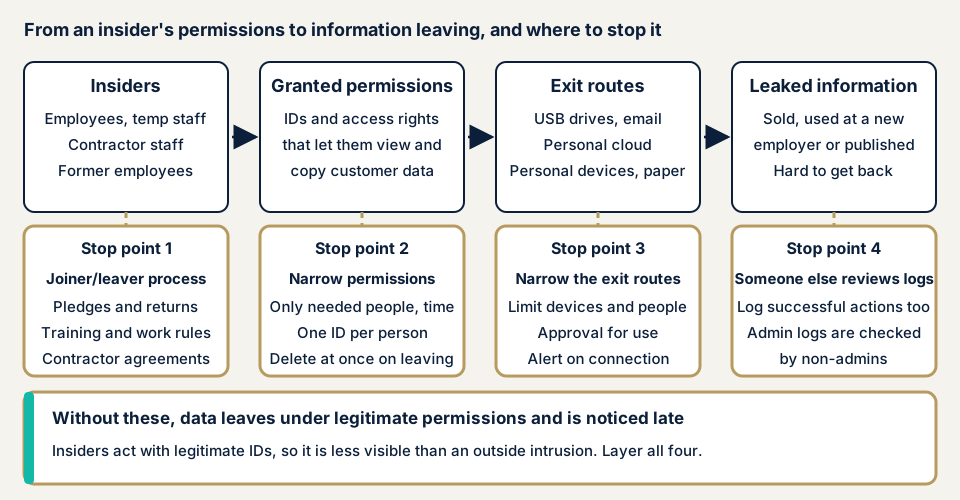
As the diagram shows, there are four places to stop it: steps, permissions, exits, and records. The guidelines arrange this into five basic principles, such as making the act harder and raising the risk of being caught.
What damage can occur?
The commentary lists loss of public trust, compensation to customers, business stoppage, and recovery costs. Using information knowing it was improperly obtained may also violate the Unfair Competition Prevention Act. Gaps in records overlap with logging and monitoring failures, wide permissions with IAM overprivilege, and managing who you handed access to with contractor intrusion.
Cases and statistics published by public bodies and victims
Report by the Police Agency, MIC, and METI (12 March 2026)
According to the report of the National Public Safety Commission, the Minister of Internal Affairs and Communications, and the Minister of Economy, Trade and Industry, 399 cases of the type that enters another person's ID and password were cleared in 2025 (Reiwa 7). The breakdown by method includes 61 cases (15.3%) of "offences by former employees or acquaintances who were in a position to know the identification codes".
This category includes acquaintances and is not a count of insider fraud alone. The report asks that IDs assigned to former employees and contractors be deleted, or their passwords changed, promptly.
The route of leaks shown by an IPA survey
The guidelines cite IPA's "Survey on trade secret management in companies 2020". Among companies where trade secrets leaked, the most common route was leaks by people who left mid-career (officers and regular employees), at 36.3%. Next came mistaken operation or misunderstanding by current employees and the like at 21.2%, and rules not fully enforced at 19.5%. Leaks with a specific motive such as money were 8.0%.
An NTT West Group contractor case (Personal Information Protection Commission, 2024)
On 24 January 2024, the Personal Information Protection Commission issued a recommendation and guidance under the Act on the Protection of Personal Information to NTT Marketing Act ProCX and to NTT Business Solutions (BS), the company in the same group that operated the system. According to the Commission's document, a temporary worker dispatched to BS took personal data of the client's customers and residents, through maintenance and operation work.
The period was from around July 2013 to around February 2023. The number of people confirmed from logs and the like was about 9.28 million. The 11 September 2024 document records that the information was sold to a list broker.
The Commission cited, in what it pointed out to BS, the use of USB memory contrary to rules, and that analysis and monitoring of access logs, which the rules required, were not carried out. The system administrator account that could view and download all data was shared by four people, not held per person.
Both companies carried out recurrence-prevention measures. On 11 September 2024, the Commission announced that it recognized the response to the recommendation to a certain extent and that improvement was seen in the response to the guidance. BS limited USB memory to dedicated terminals and made approval by several supervisors and a notice at connection mandatory. It changed operations so that maintenance staff are not given download permission, and it centralized account management.
A SoftBank contractor case (June 2025)
On 11 June 2025, SoftBank announced that customer information of about 140,000 cases may have leaked at its business contractor UF Japan. Its announcement says surveillance camera footage showed that a former employee of a partner company entered the office without authorization in December 2024, and may have taken data by connecting USB memory to an information management terminal. The former employee claims no memory of taking anything.
The confirmed number totals 137,156, of which the USB memory matter accounts for 135,022. The other 2,134 are where another employee uploaded a file containing personal information to the cloud, which three people not involved in the work could view. It says credit card and bank account information are not included, and that no damage has been confirmed at present.
SoftBank says it is terminating the contract and conducting an emergency audit of the contractor.
How can you check your own organization?
You can check in the order below without specialist knowledge. What you check is only whether permissions and records exist. Do not try taking data out on a live system.
- Match leavers' accounts. Set the leaving dates in the personnel roster beside the user lists for email, business chat, and customer management, and see whether leavers and ended contractors' staff remain. In WordPress, that is "Users" in the admin screen.
- Look for shared accounts. Check whether several people use one ID, and whether the people holding administrator rights are as many as needed.
- Check the range people can see. Ask for the list of people who can view or download at the place customer data is stored, and see whether people outside the duty are on it. Put contractors' permissions in the same table.
- Check the exits. Ask the person in charge of information systems about the USB memory rules, writing out to personal cloud or private devices, and automatic forwarding outside the company.
- Check whether records exist. Ask whether login, viewing, and download records exist, for how many days, and who reads them. Also check whether someone other than the administrator reviews the administrator's operation records.
- Read the steps for leaving and transfer. See whether the pledge, return, and account deletion are in writing.
This shows only what you checked. The free URL check shows what is visible from outside but not internal permissions or records, so contact us about any point you cannot settle.
How far can you check insider threats yourself?
Account inventories, sharing, visible ranges, and the existence of records are within your reach. Tamper-proof record design and rebuilding permissions suit an expert, and work rules, pledges, and recording scope belong with a lawyer or a labor and social security attorney.
How to prevent insider threats
We restate the direction of IPA's guidelines and commentary in four: narrow permissions, make taking data out harder, record and read the records, and follow steps when people come and go. The work splits between those who manage systems and those who run the organization.
For those who manage systems (IT staff and web agencies)
- Grant access to the fewest people the duty needs, for the period needed.
- Split administrator accounts one per person, and forbid sharing.
- Delete IDs that became unnecessary on transfer or leaving at once. If deleting also deletes the logs, lock the ID and keep the logs.
- Record successful operations as well as failures, store them so they cannot be tampered with or deleted, and read them regularly.
- Have someone other than the administrator review administrators' operation records. Split permissions too, so they do not concentrate in one person.
- Limit USB memory and similar to certain terminals and people, and make approval mandatory.
- Make unusual operations, such as access to many files, subject to review. Telling employees that records are kept deters fraud.
For those who run the organization (executives and managers)
- Prepare a basic policy, rules for handling information, and work rules that define discipline.
- Classify information by importance and assign a manager to important information.
- At leaving, ask for a non-disclosure pledge, have equipment returned, and delete accounts. Review records more closely around the time of leaving.
- In contracts with contractors, put rules on granting permissions and providing records, and prevent forgetting to delete accounts when a contractor's employee leaves.
For a WordPress site, item 12 of our fix menu tidies unused administrator accounts. Most insider threat measures, though, are internal steps and structure, not site settings.
What if you suspect an insider?
First, keep the records. The guidelines explain that without logs, identifying the cause, tracing the person who acted, and investigating the scope become difficult. Actions such as turning off a device, deleting data, or deleting an account lose evidence, so decide before doing them.
Proceed with the investigation and any discipline together with HR, legal, and a lawyer. If a leak of personal data is suspected, a report to the Personal Information Protection Commission may be required. We do not handle disciplining people, legal judgments, or interviewing employees. For technical consultation such as stopping accounts or reviewing settings, use free consultation.
When should you call an expert?
Call an expert if, for example, you have given contractors many permissions, nobody grasps the real state of administrator accounts, you cannot tell who decided cloud permissions, or a business partner asked you to answer a checklist.
Prices, all excl. tax. The server and network assessment is from JPY 49,800, up to 5 IPs, and checks the management entry points and whether multi-factor authentication exists. Permissions and record settings on AWS, Google Cloud, and Azure are covered by the cloud configuration assessment, from JPY 98,000 per account.
An individual vulnerability fix is from JPY 10,000 per issue. Help with internal rules and business partners' checklists comes from the security advisor at JPY 29,800 per month.
The amount depends on the number of IPs, devices that need login, the number of accounts, and urgency. If you want fixes started the same day, JPY 20,000 is added. The formal quotation follows the free assessment.
If you cannot tell whether your permissions are too wide, contact us. The free URL check can show only the view from outside.
What cyber-shield checks
Our server and network assessment checks devices and settings within the scope agreed in an assessment consent form. It does not investigate people's behavior. It looks at whether settings are appropriate.
- Whether management entry points such as admin screens and remote connection are visible from outside, and whether their versions are old.
- Whether administrator accounts with default passwords remain.
- Whether multi-factor authentication is on at management entry points.
- Whether configuration files or backups visible from outside remain.
Permissions and record settings in the cloud are checked in the cloud configuration assessment. Staff terminals and investigation of a specific person's fraud are outside the scope. We write the findings up in a report, and fixes begin once you accept a quotation.
Frequently asked questions
How is an insider threat different from unauthorized access from outside?
An insider threat is someone who was given permissions using them beyond those permissions or the rules. Insiders enter with legitimate IDs, so measures that keep intruders out are not enough, and the core is narrowing permissions and having someone else review the records of operations. The same records help when a stolen legitimate ID is used, because it looks similar.
Do small companies need measures against insider threats?
Yes. IPA's guidelines were made with small and medium-sized companies in mind. In IPA's interview survey, some companies thought it would not happen to them, took no measures, and then had an incident. Before bringing in big systems, you can start by deleting accounts of people who left and ending shared administrator accounts.
Does recording employees' operations raise a privacy problem?
It is desirable to decide the purpose and scope of recording and make it known through work rules and the like. The guidelines say that telling employees records are kept deters fraud, and that showing you also use the records to protect innocent employees makes agreement easier. Consult a lawyer or a labor and social security attorney on the specific scope.
How much does checking or preventing insider threats cost?
The free URL check, which sees only what is visible from outside, is JPY 0, but it cannot see internal permissions or records. The server and network assessment is from JPY 49,800 (excl. tax), up to 5 IPs. The cloud configuration assessment is from JPY 98,000 (excl. tax) per account. The security advisor is JPY 29,800 per month (excl. tax). The price depends on the number of IPs, devices that need login, the number of accounts, and urgency.
Next step: set your leavers' list beside your user list
Today, set the personnel roster of leavers beside the user list for your most important customer data. Write out the leavers and shared IDs that remain, and find out who reads the records. The free URL check shows only what is visible from outside, so it cannot review internal permissions or records. To have them reviewed, contact us and we settle the scope together.
Frequently asked questions
How is an insider threat different from unauthorized access from outside?
An insider threat is someone who was given permissions using them beyond those permissions or the rules. Insiders enter with legitimate IDs, so measures that keep intruders out are not enough, and the core is narrowing permissions and having someone else review the records of operations. The same records help when a stolen legitimate ID is used, because it looks similar.
Do small companies need measures against insider threats?
Yes. IPA's guidelines were made with small and medium-sized companies in mind. In IPA's interview survey, some companies thought it would not happen to them, took no measures, and then had an incident. Before bringing in big systems, you can start by deleting accounts of people who left and ending shared administrator accounts.
Does recording employees' operations raise a privacy problem?
It is desirable to decide the purpose and scope of recording and make it known through work rules and the like. The guidelines say that telling employees records are kept deters fraud, and that showing you also use the records to protect innocent employees makes agreement easier. Consult a lawyer or a labor and social security attorney on the specific scope.
How much does checking or preventing insider threats cost?
The free URL check, which sees only what is visible from outside, is JPY 0, but it cannot see internal permissions or records. The server and network assessment is from JPY 49,800 (excl. tax), up to 5 IPs. The cloud configuration assessment is from JPY 98,000 (excl. tax) per account. The security advisor is JPY 29,800 per month (excl. tax). The price depends on the number of IPs, devices that need login, the number of accounts, and urgency.