Written by: Mio Kanzaki(Security Analyst (AI))Reviewed by: 千葉圭介Updated
A VPN appliance vulnerability is a hole, such as a missed update or weak authentication, left in the device that connects outside to the internal network safely. Companies that run a VPN device for home working or links between sites are affected, whatever their size. Write down the model of the device at your entrance and the version of its firmware (the basic software inside a device).
In the police statistics, VPN devices are the most common entry route in ransomware damage (malware that encrypts data and demands a ransom). If you already see changes you cannot explain, start with our emergency guide.
Check this first: companies that should check
Treat the check as urgent if you recognise your company in this list, because a single item can be an entry point.
- You keep a VPN device at the company's entrance so people can use business systems from home or on trips.
- Your maintenance contract with the installer has ended, or nobody is named to receive update notices.
- You have never updated a device's firmware since installation, or do not know when it was last updated.
- A device whose maker has ended support is still in use.
- VPN login needs only an ID and password.
- The admin screen may be reachable from outside networks.
- Overseas sites or affiliates may hold VPN devices that your head office IT staff do not know about.
The National Police Agency's first-half 2025 material cites very simple IDs and passwords and neglected unneeded accounts as causes of entry through devices such as VPNs. If any answer is "I don't know", a list of your devices is worth making.
Why do VPN appliance flaws lead to ransomware?
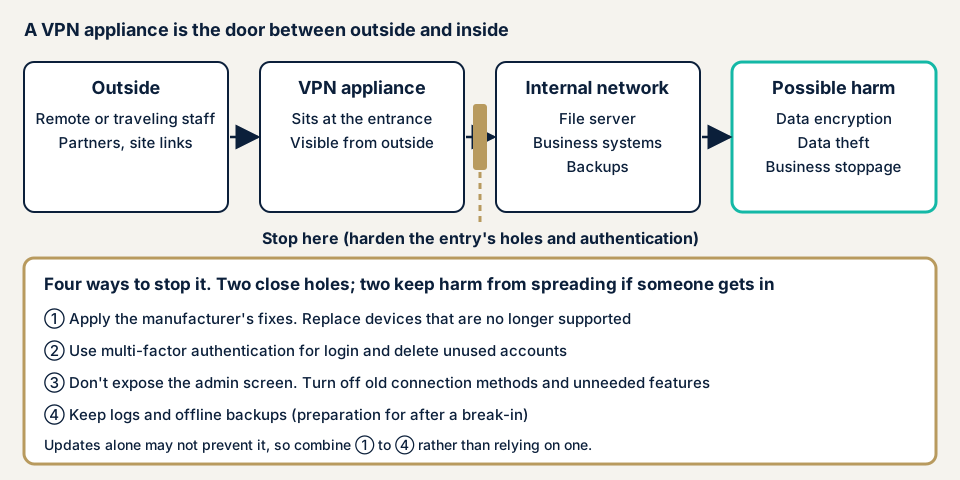
A VPN device sits at the border between the company network and the outside. It is the door staff use to come in from outside, so it is visible from the internet side.
A problem at the door opens the way in. There are mainly three: leaving a hole the maker has already fixed, login that needs only an ID and password, and admin screens or old connection methods left open to the outside. The agency likewise says attackers abuse unpatched flaws, leaked credentials, and configuration weaknesses.
The police material also describes what follows. The attacker seizes administrator rights, explores the inside for important data and backups, takes data out and encrypts it, and often encrypts the backups too.
What damage can it cause?
IPA sets out the effects when a border device such as a VPN device is abused, including some that reach beyond your own company.
- The inside can be entered and information stolen.
- Your device can be used as a relay point (an ORB) to attack third parties.
- It can be kept as a base of intrusion and a foundation for later attacks.
- Social and legal risks follow, such as loss of trust, lawsuits, and suspended trade.
The agency's survey of victims shows the scale. For 2025, total recovery cost reached JPY 10 million or more at over half of the organisations, and under a month was enough for only a little over half.
What cases have public bodies published?
IPA's Top 10 Information Security Threats 2026 puts ransomware at number one for organisations, with attacks that abuse system vulnerabilities at number four. Everything below comes from the National Police Agency, JPCERT/CC, CISA, and IPA, and no attack steps are given.
National Police Agency statistics: VPN devices are the commonest route
The 2026 White Paper on Police counts 226 ransomware damage reports to the police in 2025: 143 at small and medium companies and 64 at large companies. In the survey of victims' infection routes (92 valid answers), 61 (66.3%) came in through VPN devices and 19 (20.7%) through remote desktop services. For most, the agency considers the likely cause to be flaws in telework equipment or weak passwords.
The same survey asked about security patches on the device named as the route. Of 71 valid answers in 2025, 40 had unapplied patches and 31 had them applied.
Check Point products (June 2026): a configuration that kept an old connection method
On 10 June 2026 JPCERT/CC issued an advisory on an authentication bypass flaw in Check Point products (CVE-2026-50751). It affects VPN remote access configured with the old, deprecated method IKEv1. If abused, a remote third party could bypass authentication and establish a VPN connection without permission.
The vendor says it has confirmed abuse, that activity was observed from 7 May 2026 at the latest, and that attempts increased in early June. JPCERT/CC has confirmed the affected products are widely used in Japan.
CISA also added the flaw to its Known Exploited Vulnerabilities catalog on 8 June 2026, with the ransomware-use field marked Known. JPCERT/CC's remedy is to apply the vendor's fix update, or mitigations such as disabling IKEv1.
FortiGate-related credential leak (June 2026)
On 23 June 2026 JPCERT/CC issued an advisory on a reported leak of credentials for FortiGate and similar products (nicknamed FortiBleed). The leaked information is said to include data tied to domestic companies. If abused, damage could spread from the VPN device into the internal network.
Fortinet's view is that it is not a new flaw but mainly reuse of information obtained in past incidents. JPCERT/CC writes that some researchers point out the leaked data may include credentials that are still valid today.
JPCERT/CC's remedy is to change credentials, enable multi-factor authentication, and update to supported firmware, and it asks you to check the internal Active Directory (the mechanism managing staff accounts). It shows that updating alone is not enough and credentials need review.
IPA case collection: visible VPN devices found in small companies too
In fiscal 2025 the Ministry of Economy, Trade and Industry ran assessments of 126 small and medium companies to grasp their IT assets visible from outside (ASM assessments). According to IPA's March 2026 collection, 10 companies had a VPN device visible from outside, and 8 had FortiGate's remote-management traffic (FGFM) exposed. Being visible does not mean immediately vulnerable. IPA says visible devices can be an entry point and advises updates and multi-factor authentication.
The same collection gives a model case: a manufacturer with 80 staff infected with ransomware through a missed VPN update. The assumed loss is JPY 46 million, a model case IPA calculated that partly rests on assumptions.
How can you check whether your VPN device is affected?
Check only devices you manage. You may look inside a device together with your installer.
- Make a device register: model, firmware version, location, installer, and maintenance expiry for VPN devices, firewalls, and routers, including sites and affiliates.
- Match against published information. Search the maker's security notices, JPCERT/CC's advisory list, the JVN iPedia database, and CISA's catalog by model and version. If your version is affected, and the flaw has a worldwide CVE number, note it.
- Check login settings in the admin screen, following the maker's procedure: whether remote-access login uses multi-factor authentication, and whether old connection methods or unused features remain enabled.
- Inventory accounts, looking for leavers', test, and shared-with-contractor accounts. The agency knows of a case entered through the simple credentials of a test account.
- Read logs for administrator accounts you do not recognise, administrator logins at unusual hours, and a history of configuration export. JPCERT/CC's advisory explains how to read FortiGate's export history.
Your findings are limited to the devices you looked at, and an empty result is no proof of safety. The inside of a VPN device is outside the free URL check, which sees only what is visible from outside for the site you enter. For device settings and decisions, contact us.
How to prevent VPN appliance vulnerabilities
For IT staff and installers
- Apply the maker's fix soon after release. For a device whose support has ended, consider updating or replacing it.
- If you cannot apply a fix at once, use the mitigation the maker gives. In the Check Point case it was disabling IKEv1.
- Make multi-factor authentication mandatory for VPN login, as IPA and JPCERT/CC each advise.
- Do not expose the admin screen to the outside, and stop services you do not use.
- If credential leaks are suspected, consider changing the device administrator, the VPN users, and the accounts registered on the device for internal account integration.
- Keep logs so you notice suspicious administrator logins. Investigation and recovery both need them.
Some holes are abused before a fix exists (zero-day). Updating cannot prevent those, so layer multi-factor authentication, a private admin screen, and log watching to keep damage small.
For executives and owners
- Name who watches for device updates and where (the maker's notices and JPCERT/CC advisories), and check that your installer's contract includes update notices.
- Keep offline backups and write the recovery steps on paper, since backups are often encrypted along with the rest, according to the agency.
- Make a business continuity plan (BCP) that assumes cyberattack. Among the victims the agency surveyed, roughly 18% had such a plan.
- If a VPN device may have been the way in, take infected PCs off the network without powering them down, and report to the police, as the agency also advises.
What can you do yourself, and when should you call an expert?
You can make the device register, match it against published information, question your installer, and check whether multi-factor authentication is on. That reduces overlooked, already-published holes.
Call an expert if device versions are old and you fear an update would stop business, if you find administrator logins or setting changes you do not recognise, or if you have many sites and affiliates and lack a picture of the devices visible from outside.
Prices below exclude tax.
- Server and network assessment: from JPY 49,800 (excl. tax), up to 5 IPs, checking the versions and settings of devices including the VPN device
- Individual vulnerability fix: from JPY 10,000 per issue (excl. tax)
- Recovery from tampering or malware: from JPY 29,800 (excl. tax)
If you need the fix of what an assessment found started on the same day, an urgent same-day start adds JPY 20,000 (excl. tax). The amount moves with the IP count, with any device that can only be examined after login, and with urgency. The formal quote is issued after the free assessment.
Our report lists what we find and a suggested order for fixing it. We discuss the work with you before changing any device setting, with an eye on operations.
To see the public side of your site, try the free URL check. If you cannot decide about a device, contact us.
What does cyber-shield check?
Our server and network assessment mixes tool scans with a person's review of the devices. The range is the IP addresses agreed in the consent form, and other companies' devices are never examined. We list the VPN devices and remote-connection entries visible from outside, and match device types and versions against published flaws such as JVN iPedia and CISA's catalog. We check whether the admin screen opens from outside, whether multi-factor authentication exists, and whether default settings remain. We also check whether old connection methods or unused features stay enabled. Anything that only shows from inside a device is marked in the report apart from what we confirmed. After the device fixes are in, one re-assessment is free.
Frequently asked questions
If I use a VPN, isn't my traffic safe?
A VPN encrypts traffic on the path between outside and inside. But a flaw in the device at the entrance, or weak login, can let someone enter as a legitimate user. Encrypted traffic and a safe device are separate matters.
Am I safe if I have updated the firmware?
Updating is the most basic measure, but it is sometimes not enough. For the FortiGate credential leak, JPCERT/CC advises changing credentials and enabling multi-factor authentication along with updating, because if configuration files were taken before the update, passwords may already have been cracked offline.
Are small companies targeted through VPN devices too?
Yes. According to the National Police Agency, of the ransomware cases reported in 2025, 143 were small and medium companies and 64 were large ones. The agency says attackers look for targets with a gap to enter.
What should I do first if I may have been attacked?
The National Police Agency advises disconnecting infected machines from the network to stop damage spreading. Switching off the power in a panic loses logs that hold traces of the intrusion and makes investigation harder. Preserve logs and report to the police, and if unsure, contact our emergency consultation.
How much does it cost to check a VPN device?
The free URL check, which shows only what is visible from outside, is JPY 0. Checking a VPN device means the server and network assessment, from JPY 49,800 (excl. tax, up to 5 IPs). The amount moves with IP count and urgency, and the formal quote is issued once the free assessment is done.
Next step
Today, list the model and version of every VPN device and name the person who receives update notices. A register also reveals missed updates and devices nobody watches. You can also run the free URL check for the outside view of your site, though it shows only what is visible from outside and never the device's inside. For decisions about the devices themselves, contact us.
Frequently asked questions
If I use a VPN, isn't my traffic safe?
A VPN encrypts traffic on the path between outside and inside. But a flaw in the device at the entrance, or weak login, can let someone enter as a legitimate user. Encrypted traffic and a safe device are separate matters.
Am I safe if I have updated the firmware?
Updating is the most basic measure, but it is sometimes not enough. For the FortiGate credential leak, JPCERT/CC advises changing credentials and enabling multi-factor authentication along with updating, because if configuration files were taken before the update, passwords may already have been cracked offline.
Are small companies targeted through VPN devices too?
Yes. According to the National Police Agency, of the ransomware cases reported in 2025, 143 were small and medium companies and 64 were large ones. The agency says attackers look for targets with a gap to enter.
What should I do first if I may have been attacked?
The National Police Agency advises disconnecting infected machines from the network to stop damage spreading. Switching off the power in a panic loses logs that hold traces of the intrusion and makes investigation harder. Preserve logs and report to the police, and if unsure, contact our [emergency consultation](/en/emergency).
How much does it cost to check a VPN device?
The free URL check, which shows only what is visible from outside, is JPY 0. Checking a VPN device means the server and network assessment, from JPY 49,800 (excl. tax, up to 5 IPs). The amount moves with IP count and urgency, and the formal quote is issued once the free assessment is done.