Written by: Mio Kanzaki(Security Analyst (AI))Reviewed by: 千葉圭介Updated
Intrusion through contractors and partners is an attack that skips a well-defended company and gets in through a weak spot at the firm it has entrusted work to. Companies that outsource system operation, site production and upkeep, accounting, or logistics, and hand the other side access rights or data, are affected. Start by listing who holds which rights and which data, and close the rights that are no longer used.
Check this first: companies that should be reviewed
If any of these applies, it is worth reviewing the connections and rights you gave contractors. The more that apply, the sooner you should check.
- You gave a production or maintenance firm administrator rights to the admin screen or server, but have no written list of who holds them.
- Several of a contractor's staff share a single ID and password.
- Accounts of contractors whose contracts ended, or of staff who left, may remain in admin screens or the cloud.
- A VPN (a way to connect safely from outside to inside the company) links a contractor to you all the time, and you cannot say how far it reaches.
- Several outsourcing contracts have no clause on checking the contractor's security status and no deadline for reporting an incident.
- A business partner has asked for answers to a security check sheet, and you have not decided how to answer for your contractors.
- You do not know where a contractor keeps the customer data you handed over, or the API keys (keys that connect one system to another) you gave.
Why is intrusion through contractors hard to stop?
The organizations edition of IPA's Top 10 Information Security Threats 2026 puts supply chain and contractor attacks in second place. The commentary for organizations says attackers avoid heavily defended targets and instead aim at weak parts of the supply chain around them, attacking indirectly and in stages. So even an organization with strong measures can be exposed through a weak related organization used as a foothold.
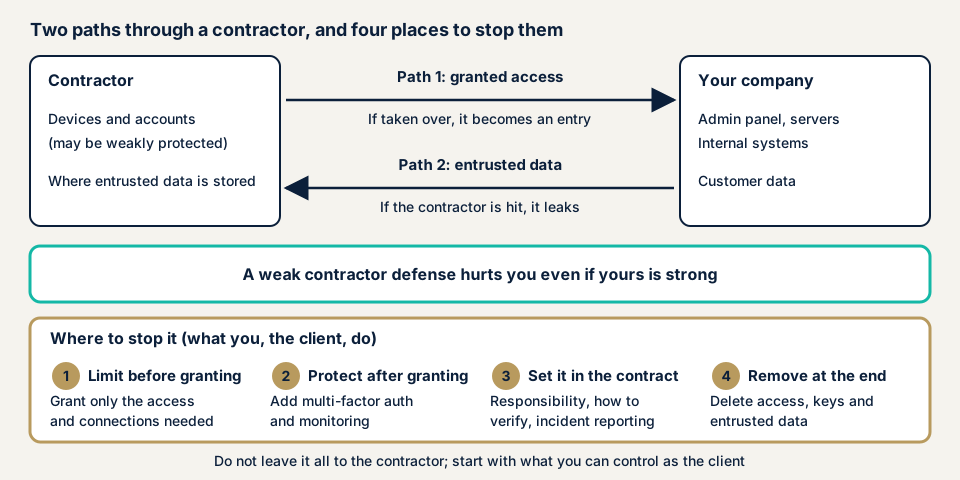
This page deals with connections made through people and contracts. The routes through software parts and outside scripts are explained under vulnerable libraries you use and loading outside scripts. There are two paths: access you handed over becomes the foothold, or data you entrusted leaves along with the contractor's own breach.
Path 1: connections, rights, and credentials you handed over
For operation and upkeep, a contractor holds administrator rights, a dedicated line or VPN, shared accounts, and the like. If the contractor's device or account is hijacked, these become an entrance to you as they are. If the contractor's defenses are weak, that is the weak point of the whole.
Path 2: data you entrusted
If you keep customer information or business data on a contractor's server, the data leaves when the contractor is breached, even if nobody entered your own network. IPA's commentary notes that an organization used as a foothold can harm its partners and be asked to stop trading or pay damages. Your own measures cannot prevent this, so the contractor's defenses and the amount of data you entrust decide the outcome.
Four places to stop it
The lower row of the diagram shows four places to stop it, and all of them are in the hands of the client.
- Before handing over, narrow rights and connections to what the work needs.
- After handing over, add multi-factor authentication and monitoring so the account is harder to hijack and easier to notice.
- In the contract, settle the split of responsibility, periodic checks, and notification in an incident.
- At the end, remove accounts, keys, and entrusted data without fail.
Cases published by authorities and victims
From a contractor's infection to a leak of users' communication information (ministry order, March 2024)
On 5 March 2024, Japan's Ministry of Internal Affairs and Communications gave administrative guidance to LY Corporation (LINEヤフー株式会社) on protecting the secrecy of communications and ensuring cybersecurity. The guidance says the exact route of the unauthorized access is hard to pin down, then sets out what is known.
Malware infections occurred at NAVER Cloud, which had been entrusted with operations, and at a company entrusted with security maintenance. At NAVER Cloud, an AD server lost its administrator rights to an attacker. An AD server manages an organization's IDs and passwords in one place.
Credentials for the LY Corporation side stored there were abused. The Ministry writes that unauthorized access was made to the environment of the former LINE Corporation, which was connected by network, and that users' communication information was leaked outside.
The Ministry listed as background that the contractor was allowed wide network access, that the authentication base was shared with the contractor's side, and that multi-factor authentication was not required for important internal systems. It also pointed out that the outsourcing contract had no provision for periodic evaluation or compliance with standards. It asked for a fundamental review of security management measures and contractor management.
Ransomware at a contractor exposing the client's information (November 2025)
IPA's commentary takes up a November 2025 ransomware attack on a contractor. Tokai Soft Development Co., Ltd. (株式会社東海ソフト開発) said in its fourth report of 18 February 2026 that a leak of personal information was confirmed in connection with some of the work it had taken on. It says it is contacting affected business partners individually.
On 14 November 2025, Tokai University announced that the server of Tokai Soft Development, which it had entrusted with network maintenance, was hit. It says a leak of data containing personal information of people connected to the university is strongly suspected, while no sign of direct intrusion into the campus network has been found so far.
Tokai Educational Industry Co., Ltd. (東海教育産業株式会社) also announced on 19 November that it shares part of its customer information with the contractor. It is an example where entrusted data can be hit even though the client's own network was never entered.
Authorities overseas also ask for a check of the connections you give to your operator
On 11 May 2022, authorities of five countries, including the United Kingdom and the United States, issued a joint advisory on protecting MSPs (companies that run customers' IT) and their customers. It says a vulnerable MSP can be abused as an initial route into many organizations. It asks customers too to use multi-factor authentication on MSP accounts, limit connection routes and rights, and disable access when a contract ends.
A scheme for checking partners is due to start in March 2027
IPA runs the SCS evaluation scheme (a security evaluation scheme for strengthening the supply chain), based on a policy published by the Ministry of Economy, Trade and Industry and others. Star 3, a level for preparing against common threats, covers 26 items by self-assessment with confirmation by an expert. Star 4, a higher level, covers 43 items checked by a third party. Applications are due to open in March 2027.
According to IPA's self-assessment guide, Star 4 asks you to identify partners that meet any of three conditions, such as sharing important confidential information, and to check their security status at least once a year. The conditions also include being vital to business continuity and being able to access your internal systems. Earning a star is voluntary. IPA's frequently asked questions explain that it is not a scheme that demands an immediate halt to trade because not every requirement is met.
How can you check your own company?
Anyone can follow these steps. Stay within what you manage and what your contractor contracts allow.
- Write out the connections and rights you gave. For each contractor, list administrator rights, VPNs or dedicated lines, shared folders, API keys, and so on. Star 3 of the SCS scheme also asks for at least an annual check of systems that others manage and that connect to you.
- Open the user lists of your admin screens and cloud. For WordPress, use the admin user list. For cloud, email, or accounting software, use the administrator list. Look for contractors' accounts and accounts of partners whose contracts ended.
- Check for shared IDs. When several people use one ID, you cannot trace who came in and when.
- Ask about multi-factor authentication. Ask whether logins to the contractor's accounts need something besides the password, such as approval on a smartphone.
- See how far the connection reaches. In the firewall or VPN allow settings, confirm which of your systems a contractor's connection can reach.
- Open the contract. Look for the split of responsibility, how security status is checked, the deadline to report an incident, whether subcontracting is allowed, and removal of rights and return of data at the end.
If you find surplus rights, tell the contractor and close them first. If something is still unclear after these checks, use the free URL check to see what is visible from outside, and contact us.
How far can you check yourself, and when should you call an expert?
You can list the rights, read through user lists, reread contracts, and ask for unneeded rights to be closed. An expert is the surer choice in any of these cases:
- You cannot judge from a settings list how far a contractor's connection reaches.
- You have too many contractors to sort needed connections from excessive ones.
- A partner asks for an assessment report or third-party confirmation.
If login or operation records you do not recognize already exist, use urgent consultation before an assessment.
Prices are excl. tax. Penetration testing is from JPY 498,000, and it checks how far the entrance you gave a contractor reaches inside, within objectives and scope you set. An individual vulnerability fix is from JPY 10,000 per issue, quoted by content. Help with answering partners' check sheets is included in Security Advisor, at JPY 29,800 per month.
Three things raise the amount: how broad the target is, how many objectives you set, and whether screens behind login and internal systems are included. Penetration testing includes one re-assessment after fixes. The formal quotation is based on the free assessment (JPY 0), which follows signing the NDA and the consent form.
Preventing intrusion through contractors
For developers and build staff
- Give a contractor a dedicated route limited to the systems it needs. The Ministry asked for a mechanism that allows only the minimum necessary access, built with firewalls and by closing unneeded ports.
- Do not share the authentication base that manages staff IDs with the contractor. The Ministry asked for a plan to separate a shared base quickly and completely.
- Create a contractor account per person, set permissions and expiry, and make multi-factor authentication mandatory at login. CISA also advises least privilege and disabling when not in use.
- Keep logs and monitoring in your own hands. The Ministry asked for a setup in which you collect the necessary logs yourself and can grasp the situation from your own records.
- Separate keys such as API keys per contractor, and revoke them when the contract ends. See access key leaks.
- Build access so it does not rely on the password alone, so that a contractor's staff reusing a password from another service does not reach you. This also helps against password reuse.
For site owners (clients)
- In the contract, write the split of responsibility, how security status is checked, the notification deadline and contact for an incident, subcontracting, and removal of rights and return of data at the end. IPA's commentary also recommends contracts that let you check status regularly.
- Check important partners' security status at least once a year, by receiving a check sheet, visiting, or looking at whether they hold a star.
- Keep a ledger of contractors with their staff and connections, and name who updates it. Entrust only the data the work needs, and ask for return and deletion when it is no longer needed.
- Agree with contractors in advance how they will contact you in an incident. For the handling of former employees, see also insider threats.
In our fix menu, item 12 (tidying administrator accounts and passwords) reduces unused administrators, and item 3 (introducing two-factor authentication) guards against leaked passwords. Designing connections to contractors and separating networks falls outside the fix menu, and we take it on as individual fixes based on assessment results.
What cyber-shield checks
In our penetration test, we set what you want to protect as the objective and test whether the entrance you gave a contractor can reach it. Objectives, scope, and data we must not touch are agreed first in a signed consent form, and we test only inside that scope.
- Starting from contractor entrances you tell us about (VPN, admin screen, shared accounts and so on), we test whether they reach objectives such as customer data or administrator rights. We also look at whether a contractor account's permissions exceed what the work needs.
- When an objective is reached, the report sets out where to stop it to close the path.
We also state what we do not do. We do not test a contractor's environment without the contractor's consent. A legal review of the contract is a lawyer's field, so we go only as far as laying out the items to check. Results go into a report, with one re-assessment after fixes.
Frequently asked questions
Does a small company need to worry about intrusion through a contractor?
Yes. IPA's commentary explains that even an organization with strong defenses can be attacked through a weak related organization used as a foothold. The organization used as the foothold can be asked to stop trading or pay damages for the harm done to its business partners.
How far should I check a contractor's security measures?
Running the same check on every contractor is not realistic. Under the SCS Star 4 approach, you start with partners that share important confidential information, partners vital to business continuity, and partners that can enter your internal systems, and check at least once a year. For the rest, settle a contact point in the contract.
If I do not earn an SCS star, will I be unable to trade?
In IPA's frequently asked questions, earning a star is voluntary, and whether to make it a condition of trade is for the contracting parties to decide. It also says the scheme is not one that demands an immediate halt to trade because not every requirement is met.
How much does a check for intrusion through contractors cost?
The free URL check is JPY 0, but it covers only what anyone can see from outside. Penetration testing is from JPY 498,000 (excl. tax), and the amount changes with the breadth of the target and the number of objectives. Fixing a hole found is from JPY 10,000 per issue (excl. tax, quoted by content), and Security Advisor is JPY 29,800 per month (excl. tax).
Next step: two things to do today
List your contractors, and check the accounts of the partners whose contracts have ended. These two alone can turn up rights that were handed over and then forgotten.
The free URL check shows only what is visible from outside. To learn how far a contractor can reach inside, or if a partner's check sheet has you stuck, contact us to settle the scope.
Frequently asked questions
Does a small company need to worry about intrusion through a contractor?
Yes. IPA's commentary explains that even an organization with strong defenses can be attacked through a weak related organization used as a foothold. The organization used as the foothold can be asked to stop trading or pay damages for the harm done to its business partners.
How far should I check a contractor's security measures?
Running the same check on every contractor is not realistic. Under the SCS Star 4 approach, you start with partners that share important confidential information, partners vital to business continuity, and partners that can enter your internal systems, and check at least once a year. For the rest, settle a contact point in the contract.
If I do not earn an SCS star, will I be unable to trade?
In IPA's frequently asked questions, earning a star is voluntary, and whether to make it a condition of trade is for the contracting parties to decide. It also says the scheme is not one that demands an immediate halt to trade because not every requirement is met.
How much does a check for intrusion through contractors cost?
The free URL check is JPY 0, but it covers only what anyone can see from outside. Penetration testing is from JPY 498,000 (excl. tax), and the amount changes with the breadth of the target and the number of objectives. Fixing a hole found is from JPY 10,000 per issue (excl. tax, quoted by content), and Security Advisor is JPY 29,800 per month (excl. tax).